
Why use Kessavo
Turn a retirement question into a usable decision model
Kessavo helps you test Social Security timing, spending, taxes, Medicare exposure, and savings durability, then turns the result into a report you can actually review.
The practical use case
Most people do not need another vague retirement score. They need to know whether their current savings, spending, Social Security timing, and tax exposure create a plan that appears to hold together under the assumptions being used.
Kessavo is built for that moment. It gives you a structured first pass before you make a claiming decision, adjust spending, compare another calculator, or sit down with a professional.
What the report helps you do
A claim-age comparison you can explain
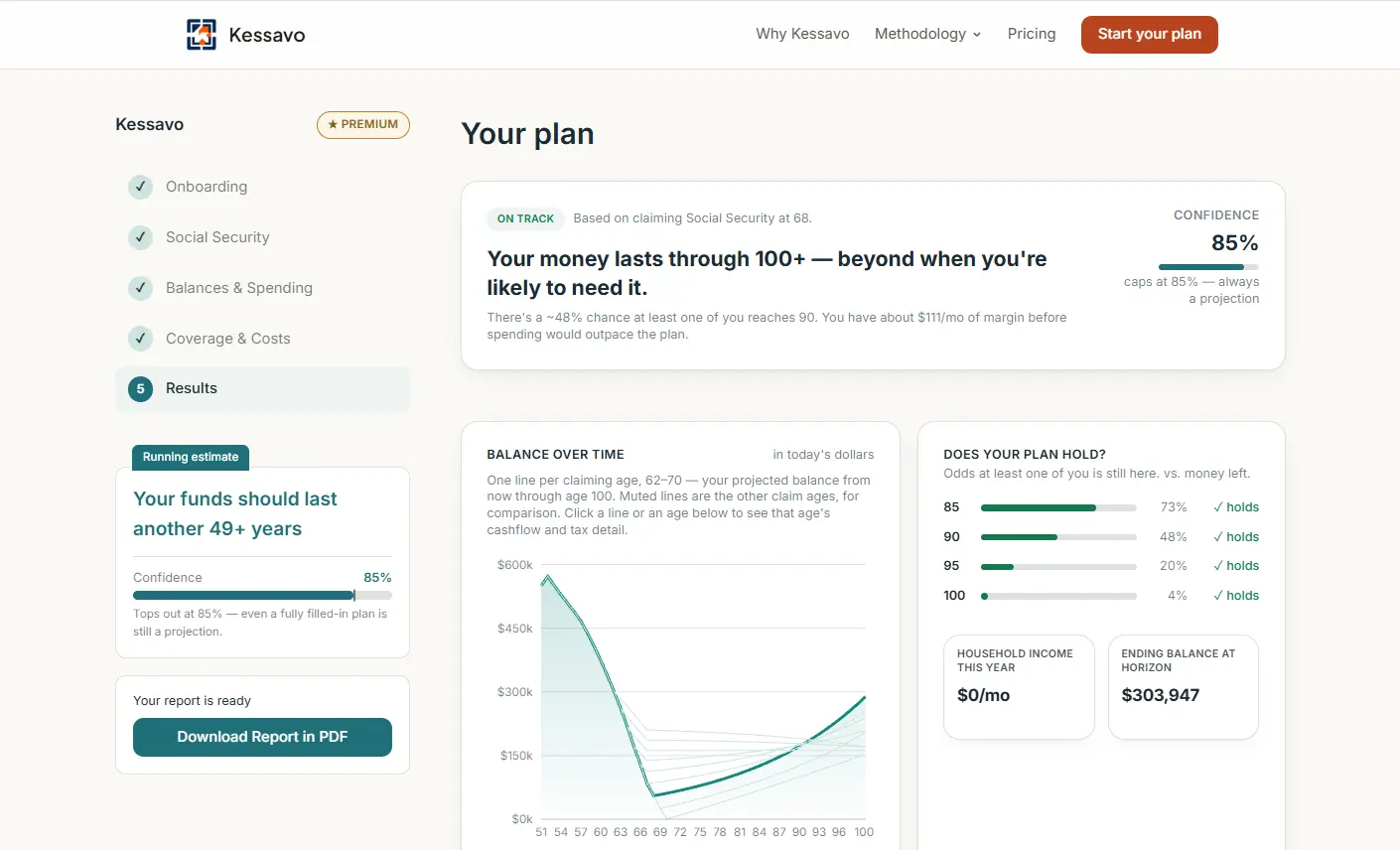
See how claiming Social Security earlier or later changes cashflow, taxes, Medicare exposure, and the projected life of your savings.
A year-by-year view of the moving parts
The report breaks the plan into balances, income sources, withdrawals, taxes, and health-cost pressure instead of hiding everything behind one final number.
A cleaner conversation with a planner
Bring the report to a financial planner, tax professional, or spouse so the conversation starts with concrete assumptions instead of vague worry.
A plain-English audit trail
Kessavo shows the formulas and assumptions behind the model, then flags the places where the result should not be treated as the last word.
Where the model is strongest
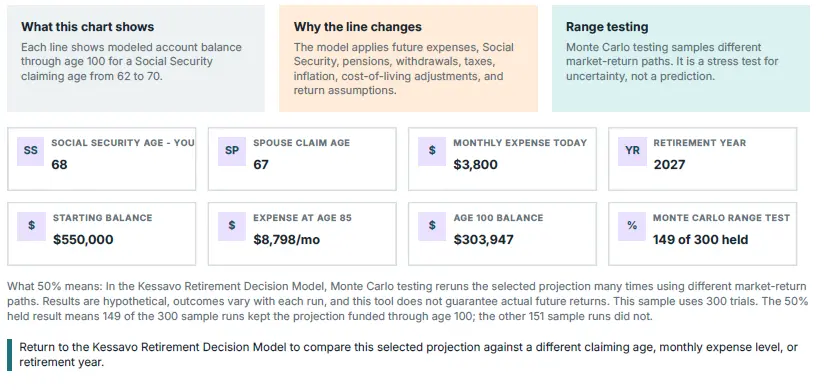
Kessavo is most useful when you want a transparent first pass across the concerns that usually drive retirement anxiety: running out of money, tax surprises, Medicare shocks, and market risk. The chart also shows where the model stops instead of pretending to know more than it does.
What Kessavo gives you, and what it does not
It is
- A way to test whether a planned retirement age, spending level, and Social Security claim age hold together.
- A private first pass — the calculator runs in your browser, so your inputs are not sent to a Kessavo server.
- A reportable scenario you can review, print, save locally, or bring into a professional conversation.
- A model that shows its assumptions instead of asking you to trust an unexplained score.
- A practical way to find the questions worth asking before you pay for personalized advice.
It isn't
- Financial or fiduciary advice — it models, it does not recommend, and it will not tell you what to do.
- A substitute for a licensed financial planner — it is what you bring to one.
- A guarantee. A projection is arithmetic run forward on assumptions you chose; change an assumption and the answer changes.
- Complete. Estate, insurance, portfolio construction and tax-return-grade detail sit outside the model, and the report names them rather than quietly leaving them out.
A list like that can read as so why bother. It is the opposite. The reason to know where a model stops is that the places it stops are the places worth paying a professional for — and a standalone comprehensive financial plan runs a median of $3,000 (The Kitces Report, 2024 data).
Walking into that meeting already knowing what your income covers, what your savings have to fund, and which four questions are still open is not a smaller version of the plan. It is what makes the hour you are paying for about your decisions instead of your data entry.
How to use the report
Treat the Kessavo report as a planning tool: useful for comparison, review, and better questions. It is not a recommendation to claim, retire, withdraw, convert, or buy anything.
| What | Where it stands |
|---|---|
| Before choosing a Social Security age | Compare the projected tradeoffs instead of treating 62, full retirement age, and 70 as isolated guesses. |
| Before meeting a planner | Walk in with a concrete model, clearer assumptions, and better questions about taxes, withdrawals, Medicare, and risk. |
| Before changing spending | See whether a higher or lower monthly expense changes the projected durability of the plan. |
| Before trusting another calculator | Use the assumptions and formulas as a comparison point when another tool gives you a different answer. |
| After running a scenario | Save or print the report as a snapshot of what you tested, not as a recommendation to follow blindly. |
What Kessavo actually gives you
The benefit is not a prettier calculator. The benefit is a clearer retirement conversation: what you entered, what the model assumed, what changed the result, and which questions are still too personal for software alone.
That matters when two calculators disagree, when a planner asks for your assumptions, or when you and your spouse need to compare tradeoffs without turning the whole decision into a spreadsheet project.
Kessavo gives you a private, report-ready model of the decision. It does not turn that model into financial, tax, investment, legal, Medicare, insurance, or fiduciary advice.
Curious what's actually happening between the 5 input groups you complete and the plan you get back? See what one run actually computes.